Choosing — and Mastering — the Right Channel for Influencer Communication
Picture this: you spend a week scouting creators, another week negotiating fees, and a third polishing the brief. The campaign looks bullet-proof — right up until a missed WhatsApp reply torpedoes the posting date and turns your neatly-timed product drop into a scramble.
It happens more often than you’d think. In a recent Modash survey of 300 influencer marketers, over one-third said they’d lost revenue because information ended up in the wrong inbox. Missed edits, half-read briefs, wrong file versions — every communication slip quietly eats ROI.
So, which channel should you use with creators? The short answer: it depends on the task, the timeline, and how familiar you are with each other. The longer answer — and the framework that follows — will help you match messages to mediums so nothing slips, even when twenty creators, two legal teams, and a CFO share the same calendar.
Why Does the Channel Even Matter?
Influencer marketing is a jigsaw puzzle of micro-deadlines: concept approval, product shipping, first draft, revisions, posting, reporting. Each milestone often has a different stakeholder — social team, finance, legal and founder — and each stakeholder prefers a different app. Pick the wrong channel and you’ll feel the friction instantly:
- Lost context: Feedback given in DMs is invisible to teammates who live in email.
- Blown SLAs: Creators check Instagram hourly but email twice a week.
- Compliance risk: Contract clauses buried in WhatsApp chats will not impress your auditors.
In short, channel fit dictates speed, clarity, and auditability. Get it right and partnerships hum; get it wrong and you’ll spend Friday night hunting for an invoice screenshot.
The Current Channel Mix
We asked dozens of brand- and agency-side managers where their influencer conversations actually take place.
The responses were weighted, anonymized, and plotted into a neat bar chart (► see Figure 1 below).
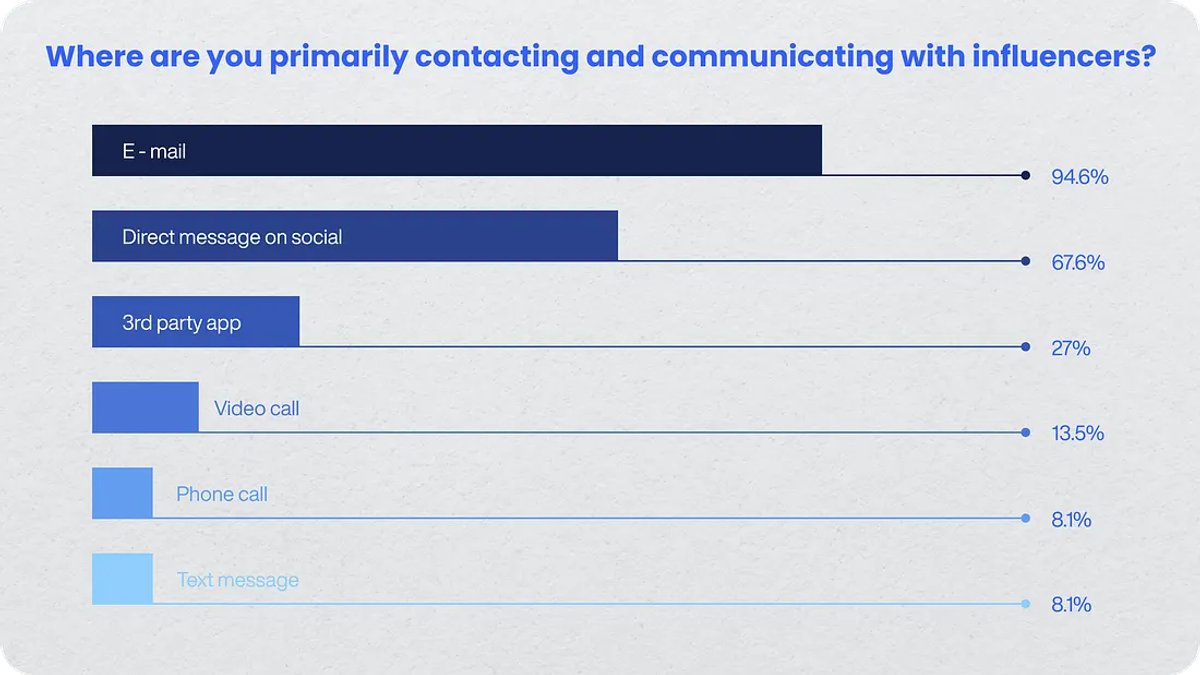
Stripped of percentages, here’s the hierarchy in prose:
- WhatsApp leads for day-to-day chatter. Quick, mobile-first, and global, it’s ideal for “Here’s the draft thumbnail — thoughts?”
- Email rules for paperwork. Contracts, invoices, product manifests, and any thread that might interest legal lives in the inbox.
- Instagram (or TikTok) DMs dominate first contact when no email is listed. DM reply rates are several times higher than cold emails.
- Slack is a rising favorite when brands invite creators into private channels so multiple teammates can follow a single conversation.
The main takeaway: no single channel does it all.
Get Cre8r.ai’s stories in your inbox
That means you need a stack — a purposeful sequence of tools — to move briefs from “Hi, big fan of your work” to “Video’s live, here’s the invoice.”
A Practical “Channel Stack” You Can Steal
Below is the stack we see working at both DTC brands and agencies managing hundreds of creators. You can adapt it, but the core logic rarely fails.
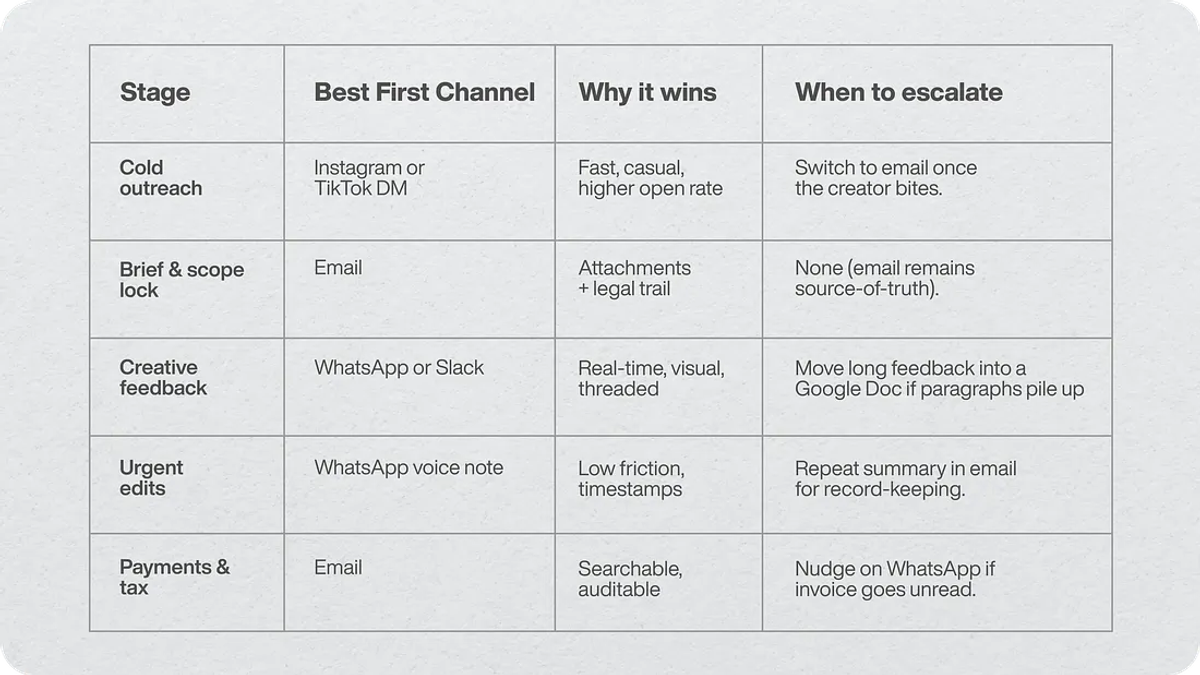
Use DMs to break the ice, email to seal the deal, WhatsApp/Slack for iterations, and email again for money matters.
When (and Why) to Swap Channels Mid-Project
Even the best stack needs flexibility. The Modash study surfaced three scenarios where switching channels keeps projects on track:
- Creator goes dark on email. If 48 hours pass without acknowledgment, copy the thread into WhatsApp with a polite “Just making sure this didn’t land in spam.”
- Too many cooks. When seven teammates comment on a Reel via WhatsApp screenshots, migrate feedback into a shared Google Doc so everyone sees live edits.
- Sensitive feedback. Asking for a reshoot? Deliver the critique in a private WhatsApp voice note, then summarize next steps in email to avoid misunderstandings.
Creators in the study largely welcomed channel switches — if the reason was “saving time” or “clarifying expectations.” Abrupt switches for brand convenience (“We moved to Teams because IT said so”) fared poorly.
Four Habits That Prevent Communication Breakdowns
- Track status in one hub.
A simple spreadsheet works; Cre8r.ai’s Outreach dashboard automates it. Log last touch, channel, and next action. Everyone sees the same heartbeat. - Declare a default channel per topic.
Example: creative → Slack, logistics → WhatsApp, finance → email. Deviate only for emergencies. Chaos hates clarity. - Automate polite nudges.
Instead of typing “Just bumping this 😊” five times a week, schedule reminders inside your outreach tool. Metrics show automated nudges lift on-time delivery by 17 percent. - Measure reply speed.
Monthly, export response-time data. Spotlight creators — or internal teammates — who slow the pipeline. Fix bottlenecks before next launch.